

Notarization and authentication are different steps. A Nigerian notary confirms a signature, copy or declaration within the notarial act. Ministry of Foreign Affairs authentication, where required, confirms the relevant Nigerian signature or seal for use abroad. Some applications need one step, some need both and others use direct verification. Check the receiving authority’s instructions before processing the document.
This guide explains what each step does, how to tell them apart and how to confirm the correct route for the document and destination.
Notarization in Nigeria: Definition and Purpose
Notarization is the process where a specially authorized Nigerian lawyer called a Notary Public examines a document, verifies the identity of the person signing it, witnesses the signature, and certifies that the document was properly executed with full understanding of its contents and legal consequences.
What the Red Seal Means
At the most basic level, the red, star-like, circular rubber seal on a document (often accompanied by a stamp bearing the name, address, and contact details of the Notary Public) is a sure sign that the document has been notarized. But what does this red seal and stamp signify?
A notary may witness a signature, certify a copy or record another notarial act. The precise effect depends on the wording placed on the document. The seal confirms the notarial act; it does not automatically prove that every fact stated in the document is true. Where a person signs before the notary, the notary also verifies the signer’s identity and records that the document was signed or acknowledged in the notary’s presence.
When you see the red seal and notary stamp on a Nigerian document, it signifies:
- Identity Verification: The notary public personally verified your identity through your passport, national ID, or other official identification
- Signature Witnessing: The notary witnessed you personally sign the document or watched you acknowledge a signature you made previously
- Understanding Confirmation: The notary confirmed you understand the document’s contents and are signing voluntarily without coercion
- Document execution: The notary records the act stated in the notarial wording, such as witnessing a signature or certifying a copy
- Professional Accountability: The notary accepts professional liability if they incorrectly certify a fraudulent or improperly executed document
Certain institutions or authorities (such as embassies or high commissions) insist on notarization of documents presented to them so they may have full faith in the validity of such documents. In effect, notarization confers an additional layer of credence or trustworthiness upon a document and the transaction it signifies.
Who Are Notaries Public in Nigeria?
In Nigeria, notarization of documents is performed by a certified Notary Public, who is often a lawyer that has been practicing at the Bar for a minimum of seven years and has applied for and received accreditation from the Chief Registrar of the Supreme Court of Nigeria. A Notary Public is ceremoniously considered an officer of the Supreme Court.
Not every Nigerian lawyer can notarize documents. Because notaries public require special appointment beyond ordinary lawyer qualification, not all Nigerian law firms offer notarization services. You must specifically seek out lawyers who hold notary public appointments.
Why Foreign Authorities Value Notarization
Embassies, immigration authorities, and foreign institutions request notarization because it adds an independent professional verification layer beyond the document itself. The notary public serves as a trusted intermediary who stakes their professional reputation and legal liability on certifying the document’s authenticity.
For foreign authorities examining thousands of Nigerian documents, notarization provides assurance that someone with legal expertise and accountability personally verified the document before it was submitted.
Authentication (Attestation) in Nigeria: Definition and Purpose
Authentication, attestation, legalization and apostille are related terms, but they are not legally identical. Nigeria does not issue apostilles because it is not part of the Hague Apostille Convention. To authenticate a document means to attest or certify that such a document is legal, genuine, and validly issued to the bearer by the claimed authority responsible for issuing such a document.
In other words, if you have a document like the official birth certificate issued by the National Population Commission of Nigeria (NPC) or a marriage certificate, authenticating such a document means getting it endorsed by the appropriate authorities whose attestation or certification of such a document effectively confers legitimacy on it for use abroad. The appropriate authority responsible for authentication of documents in Nigeria is the Ministry of Foreign Affairs in Abuja.
What Ministry of Foreign Affairs Authentication Stamps Look Like
Unlike the red notarial seal which appears on the front of documents, Ministry of Foreign Affairs authentication stamps appear on the back (reverse side) of your document, and it is usually white in colour and is accompanied by two official signatures.
Authenticated documents display:
- Official stamps and signatures from Ministry of Foreign Affairs Legal Services Division officers
- Date of authentication
- Embossed white seal from the Ministry of Foreign Affairs (you can feel the raised impression).
What Authentication Certifies
When the Ministry of Foreign Affairs authenticates your Nigerian document, they are certifying to foreign governments that:
- The document was genuinely issued by the Nigerian institution named on it (NPC for birth certificates, universities for degrees, marriage registries for marriage certificates, etc.)
- The signatures and stamps on the document are legitimate and from authorized officials
- The document meets Nigerian legal requirements for the document type
- The document can be trusted by foreign authorities for official purposes
- The Nigerian government vouches for the document’s authenticity
Ministry of Foreign Affairs authentication is Nigeria’s government authentication step. It confirms the relevant Nigerian signature or seal. Depending on the destination, it may be followed by embassy legalization; it should not be described as a Nigerian apostille.
Special Requirements for Academic Documents
However, if you have an academic result (such as WAEC or degree certificate), there are two layers to authenticating such a document. Since it is an educational document, it must first be certified by the Ministry of Education (which would ascertain and attest to its genuineness) and then subsequently authenticated by the Ministry of Foreign Affairs. Only after this dual process is completed will the educational document be deemed authenticated and presentable to embassies (for legalization) or to foreign authorities.
For Nigerians who have a foreign degree or similar academic certificates from a foreign educational institution, in order to authenticate such documents in Nigeria, you first need to get them endorsed by the embassy of the country where you studied. For example, if you studied in Ghana, you must take the degree certificate to the Ghana High Commission in Nigeria for verification and endorsement. After this is done, you will then be able to authenticate the document directly at the Ministry of Foreign Affairs without the need to go through the Ministry of Education attestation as is the case for academic certificates issued by Nigerian institutions.
Only Ministry of Foreign Affairs Can Authenticate
Authentication for international use can only be performed at the Federal Ministry of Foreign Affairs headquarters in Abuja. No state government offices, no embassies, no notaries public, and no other institutions can provide the official authentication that foreign governments require.
This centralization in Abuja creates practical challenges for Nigerians living in Lagos, Port Harcourt, Kano, or other cities, and especially for diaspora Nigerians who need documents authenticated but cannot personally travel to Abuja.
The Critical Difference: Notarization vs Authentication
Now that we understand what each process means individually, the key differences become clear:
Who Performs It
Notarization: Performed by individual Notaries Public (specially appointed lawyers) operating from law firms throughout Nigeria
Authentication: Performed exclusively by Nigeria’s Federal Ministry of Foreign Affairs in Abuja
What It Certifies
Notarization: Certifies that a specific person signed the document, understood its contents, and signed voluntarily. Focuses on the signing process and the signatory’s identity and intent.
Authentication: Certifies that the document itself was genuinely issued by the stated Nigerian institution and meets Nigerian legal standards. Focuses on the document’s origin and legitimacy rather than who signed it.
Where the Seal/Stamp Appears
Notarization: Red circular notarial seal plus rectangular notary stamp appear on the front of the document
Authentication: Ministry of Foreign Affairs stamps and embossed seal appear on the back (reverse) of the document
Processing Time
Notarization: Usually completed within hours or same day if you visit the notary public’s office with proper identification and the document to be notarized
Authentication: Official processing time is 3-5 business days at Ministry of Foreign Affairs, but delays are common during peak periods. Realistically allow 1-2 weeks.
Geographic Availability
Notarization: Available from notaries public throughout Nigeria in all major cities (Lagos, Abuja, Port Harcourt, Kano, Ibadan, etc.)
Authentication: Available only at Federal Ministry of Foreign Affairs headquarters in Abuja. No state-level or city-level alternatives exist.
Visual Example: Notarization and Authentication on the Same Document
The clearest way to understand the difference between notarization and authentication in Nigeria is to see both on the same document. The image below shows a Nigerian document that has been both notarized and authenticated. Notice the difference:
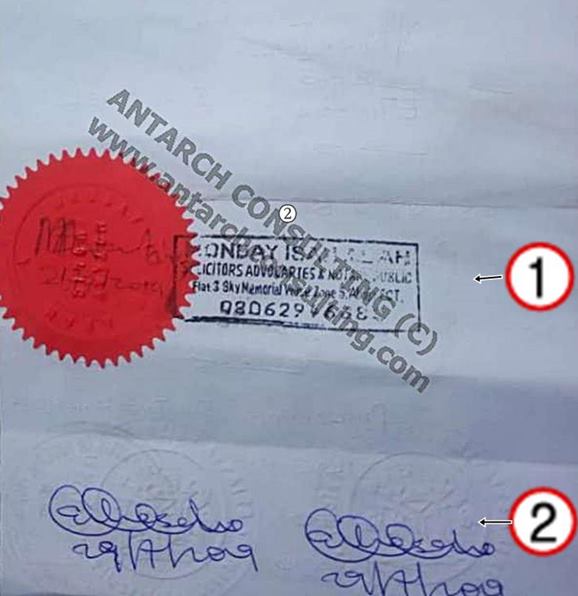
2. Ministry of Foreign Affairs authentication seal and signatures
Notice the distinct differences:
- Number 1: Red circular notarial seal and rectangular notary public stamp with the notary’s name and contact details
- Number 2: Ministry of Foreign Affairs authentication embossed stamps and official signatures
This visual distinction makes it easy to verify whether your document has been notarized only, authenticated only, or both.
When Do You Need Notarization, Authentication, or Both?
Notarization and authentication of documents often go hand in hand when the purpose is to use your Nigerian document in a foreign country. However, this is not strictly so. It is not always necessary to notarize a document before authenticating it in order to use it abroad. This requirement varies from one embassy to the other or one country to the other. You should find out from the relevant authorities (embassy or institution where you will submit the document abroad) whether notarization and authentication need to be done on a particular document you intend to use in that country.
The single most common question is: which one do I need for my documents? The answer depends entirely on your destination country and the specific document type. There is no universal rule that applies to all countries or all documents.
When authentication is actually required
Ministry of Foreign Affairs authentication is always required before an embassy can legalize a Nigerian document. It is not, however, a universal requirement for every foreign application. The receiving authority decides whether it needs Nigerian government authentication, a certified copy, direct verification from the issuer or some other form of evidence.
The differences matter. The Netherlands requires Nigerian Ministry of Foreign Affairs legalization for documents covered by its published procedure, with no later Dutch embassy step. Germany does not legalize Nigerian public documents and uses a verification process when a German authority or court requests one. The United Kingdom and Canada do not ordinarily require MFA authentication across all visa, admission or immigration applications.
When notarization and authentication are both required
Some documents must be notarized before Ministry of Foreign Affairs authentication and later embassy legalization. From Antarch Consulting’s field experience, the Chinese and Qatari embassies commonly require both steps for documents submitted for legalization. Qatar also applies document-specific requirements, particularly to university certificates and their supporting transcripts.
Do not extend that rule to every country or every document. A power of attorney, sworn statement or certified copy may need notarization because of what the document is, while an original civil certificate may not. The embassy or receiving authority’s current checklist should settle the point.
Examples of country-specific treatment
- Netherlands: Nigerian Ministry of Foreign Affairs legalization is generally the final Nigerian step for documents covered by the Dutch procedure.
- Germany: Nigerian documents cannot be legalized by the German missions. A German authority may initiate document verification instead.
- United Kingdom and Canada: authentication is not a blanket requirement for all applications. Follow the instructions for the particular visa, school, employer, registry or credential evaluator.
- China and Qatar: notarization is commonly required in addition to Ministry of Foreign Affairs authentication before embassy legalization.
How to Confirm Requirements for Your Specific Situation
Since requirements vary by country, document type, and even specific embassies within countries, always confirm exact requirements before processing documents:
- Contact the embassy or consulate of your destination country in Nigeria directly
- Ask specifically whether your document type requires notarization, authentication, or both
- Request written confirmation or refer to official embassy documentation
- Consult with professional document authentication services who have current embassy requirements
The cost of confirming requirements in advance (free or minimal) far outweighs the cost of processing documents incorrectly and facing rejection (requiring complete reprocessing at full cost plus delays).
Getting Help With the Nigerian Process
If you are outside Abuja or outside Nigeria, Antarch Consulting can review the receiving authority’s requirement and confirm which parts of the Nigerian process we can realistically coordinate. This may include notarization where the document requires it, Ministry of Foreign Affairs authentication, collection and secure delivery.
Embassy legalization is considered separately and is available only for selected destinations where assistance is feasible. Contact Antarch Consulting with the document, country and purpose before sending an original.