
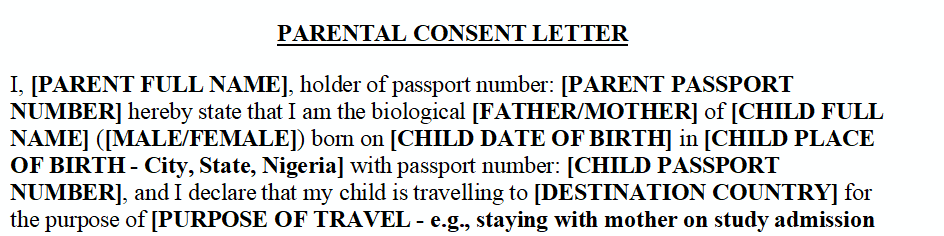

If you are a Nigerian parent preparing for your child’s international travel without both parents present, you need to understand parental consent letters. This guide explains what this document is, when embassies require it, how to prepare it correctly, and where to get it properly notarized in Nigeria or abroad. By the end, you will know exactly how to create an embassy-ready consent letter that protects your child’s travel plans.
What Is a Parental Consent Letter for Child Travel and Who Needs It?
A parental consent letter is a formal document where a parent or legal guardian authorizes their minor child (under 18 years old) to travel internationally without both parents being present. Immigration authorities, embassies, and airlines require this letter to prevent child trafficking, kidnapping, and custody disputes.
The letter must include:
- Full identification of the consenting parent
- Complete details about the child (name, date of birth, passport number)
- Information about who the child will travel with
- Clear statement of consent for the specific journey
- Destination country and purpose of travel
- Parent’s contact information
- Signature witnessed by a Commissioner for Oaths or Notary Public
This document is legally required in many situations. Without it, your child may be denied boarding at the airport, face immigration detention, or have their visa application rejected. The embassy wants proof that both parents (or the non-traveling parent) agree to the child’s international travel.
Who typically needs this letter:
- Children traveling with only one parent for study programs abroad
- Minors joining a parent who is already working or studying in another country
- Children traveling with grandparents, aunts, uncles, or family friends
- Student visa applications where the child will live abroad
- Situations where parents are separated or divorced and one parent is traveling with the child
Who does NOT need this letter:
- Adults (18 years and older make their own travel decisions)
- Children traveling with both parents together
- Domestic travel within Nigeria
When Do You Need a Parental Consent Letter?
For Student Visa Applications
Most countries require parental consent when a minor applies for a student visa. Canada, the United Kingdom, the United States, and European nations specifically request this document. The embassy wants assurance that both parents support the child’s education abroad and that there are no custody disputes.
For example, if your daughter is accepted to study in the Netherlands and her mother will accompany her while you remain in Nigeria, you must provide written consent. The Dutch embassy will not process the visa without this letter properly notarized.
For Family Visit Visas
When a child visits a parent abroad (for example, during school holidays), immigration authorities require proof that the non-traveling parent consents. This prevents situations where one parent illegally takes a child out of the country against the other parent’s wishes.
For Permanent Relocation
If your family is relocating and one parent travels ahead to set up housing and employment while the other parent follows later with children, consent letters protect everyone. The traveling parent should carry consent from the parent who already relocated. This shows immigration officials that the family unit is legitimate.
For Children with Guardians or Relatives
Nigerian children frequently travel with aunts, uncles, grandparents, or family friends (especially for weddings, funerals, or extended visits). Airlines and immigration officers are extra cautious in these situations. Both parents should ideally provide consent letters specifying who the child is traveling with and why.
When Parents Are Separated or Divorced
Separated or divorced parents face stricter scrutiny. Immigration authorities worry about parental kidnapping. If you have joint custody, the traveling parent must present consent from the non-traveling parent. If you have sole custody, bring court orders proving your custody rights.
Information and Documents You Must Prepare
Before you start writing your consent letter, gather all necessary information and supporting documents. Missing details or errors are the main reasons embassies reject these letters.
About the Consenting Parent (You)
- Full legal name exactly as it appears on your passport
- Valid Nigerian passport number
- Complete residential address (street, city, state, country)
- Phone number with country code (e.g., +234 803 XXX XXXX)
- Email address
- Photocopy of your passport data page
About the Child
- Full legal name exactly as shown on passport
- Date of birth (write Month Day, Year format)
- Place of birth (City, State, Nigeria)
- Valid passport number
- Gender
- Child’s birth certificate (original or certified copy)
About the Accompanying Person
- Full legal name as it appears on their passport
- Relationship to the child (mother, father, aunt, guardian)
- Passport number
- Any other names they use (maiden name if applicable)
- Photocopy of their passport data page
About the Travel
- Destination country and city
- Specific purpose (e.g., “joining mother for 3-year nursing program at George Brown College”)
- Name of institution or program if applicable
- Expected departure date
- Expected duration of stay
- Supporting documents like admission letters or invitation letters
Additional Documents to Prepare
- Marriage certificate (if parents are married)
- Divorce decree (if parents are divorced)
- Sole custody order (if applicable)
- Death certificate (if one parent is deceased)
Having all this information ready before you start writing prevents mistakes and ensures consistency across all visa application documents.
How to Prepare a Parental Consent Letter Yourself
You can create this letter yourself by following a clear structure. Many Nigerian parents waste money on agents who simply fill in templates. You can do this yourself if you know the correct format. You need to begin by confirming if this is the right document for your situation by checking the destination embassy website first. Some countries provide specific consent forms you must use. For example, the United States has form DS-3053 for certain situations. If the embassy requires a specific form, use theirs. If they do not specify a format, create your own following the structure below.
Also confirm that you have the legal right to give consent. If there are custody disputes, court orders restricting travel, or you are not the legal guardian, consult a lawyer before proceeding. Subsequently, you should use the checklist above to collect all passports, certificates, addresses, and dates. Verify every detail against official documents. One misspelled name or wrong passport number can cause rejection.
Common Mistakes Nigerians Make With This Document
Name Inconsistencies
The most common error is names not matching across documents. Your name must be identical on the consent letter, your passport, and your National ID. Many people have slight variations (middle name missing on one document, different spelling on another). This causes embassy suspicion.
Example of the problem: Passport says “John Chukwuma Okafor” but consent letter says “John C. Okafor.” Immigration questions the relationship.
Solution: Always use your FULL name exactly as it appears on your passport. Include all middle names.
Wrong Date Formats
Nigerians often write dates as numbers (15/06/2010) which creates confusion internationally. Americans read this as June 15th while Europeans read it as 15th June.
Solution: Write dates in words: June 15th, 2010. This prevents all ambiguity.
Missing Notarization
Some parents think simply signing the letter is enough. Embassies will reject any consent letter without official stamps from a Commissioner for Oaths or Notary Public.
Solution: Always get proper notarization before submitting your visa application.
Vague Travel Purpose
Writing “for studies” or “to visit” is too general. Embassies want specific details.
Solution: Write exactly what program, which institution, when it starts, and how long it lasts. “For a 3-year International Business Management Diploma at George Brown College beginning September 2024” is much better than “for studies in Canada.”
Expired Passport Numbers
Some parents use old or expired passport numbers because they have not updated their files.
Solution: Double-check all passport numbers. Use only current, valid passports. If someone’s passport is expired or will expire soon, renew it before preparing this letter.
Wrong Embassy Address
Using a generic embassy address or the wrong city (Abuja instead of Lagos, or vice versa) shows lack of attention to detail.
Solution: Look up the exact address of the specific embassy or consulate where you will submit your visa application. Use that exact address on your letter.
Not Explaining Name Changes
Women often change their surname after marriage. If your passport shows your maiden name but you now use your married name, embassies get confused about your relationship to the child.
Solution: Mention both names clearly in the letter: “…holder of passport number A12345678, also known as [MARRIED NAME] by marriage…” Attach your marriage certificate as proof.
Too Many Photocopies Instead of Originals
Some embassies specifically want the original stamped letter, not photocopies. Submitting photocopies can cause rejection.
Solution: Get multiple original stamped copies from the Commissioner for Oaths (3-5 copies). Submit one original with each visa application and keep one for your records.
Not Including Contact Information
Forgetting to include your email and phone number means the embassy cannot reach you if they have questions. This delays processing.
Solution: Always include current phone number (with country code) and active email address.
Save Time With a Ready-Made Parental Consent Letter Template Kit
Creating this letter from scratch takes time and research. You need to know the exact format embassies expect, which sections to include, how to phrase statements clearly, and where to get notarization.
Our Parental Consent Letter Template Kit eliminates this guesswork. The kit includes:
Professional Blank Template: Editable Word document with clear placeholders for all required information. Just fill in your details.
Completed Example: Realistic sample showing exactly how a properly filled letter looks. Use this as your reference to avoid formatting errors.
Comprehensive Step-by-Step Guide: covering every detail. Learn what documents to gather, how to fill each section, where to get notarization in Nigeria and abroad, country-specific requirements, common mistakes, and answers to frequently asked questions.
The template uses Nigeria-specific wording that addresses common immigration concerns. It meets international embassy standards and significantly reduces the risk of visa rejection due to improper consent documentation.
Thousands of Nigerian parents have successfully used our templates for student visas, family visit visas, and relocation purposes across Canada, the United Kingdom, the United States, Netherlands, Germany, and other countries.
Get the Parental Consent Letter Template Kit →
Frequently Asked Questions
Q: Do both parents need to sign the consent letter? A: It depends on who is traveling. If one parent travels with the child, only the non-traveling parent needs to sign. If the child travels with someone other than a parent (aunt, guardian, family friend), ideally both parents should provide consent. If you have sole custody, only you need to sign but you must provide court documents proving your custody rights.
Q: Can I use this consent letter for multiple visa applications? A: Each letter should be specific to one embassy and one travel purpose. If applying to different countries, create separate letters addressed to each embassy with destination-specific details. However, if making related applications to the same country (like visa extension), the original letter may still be acceptable if dates remain valid.
Q: What if the other parent refuses to give consent? A: This is a legal matter. If you have sole custody (proven by court orders), you do not need the other parent’s consent. If you have joint custody and they refuse, you may need to seek legal advice or apply to court for permission. Never forge signatures or create false documents as this is a serious crime.
Q: How long is the consent letter valid? A: There is no fixed validity period, but embassies prefer recent documents (within 3-6 months of application). If travel plans change significantly (different dates, different destination), create a new letter with updated information.
Q: Can I use this if my name changed after marriage or divorce? A: Yes, but clearly explain the name change in the letter. Mention both your current name and your name as it appears on your passport. For example: “I, Jane Smith, holder of passport A12345 issued as Jane Williams (maiden name)…” Attach your marriage certificate or court order showing the name change.
Q: What if the embassy has their own specific consent form? A: Always check the destination embassy website first. Some countries (especially USA and Canada) have official forms. Use their form when required. However, you can still attach your detailed consent letter as supplementary documentation if their official form is very brief.
Q: Do I need to translate the letter if the destination country does not speak English? A: Most embassies accept English documents for visa applications. However, check specific requirements. Some countries require certified translations. If needed, hire a certified translator and submit both the English original and the certified translation.
Q: Can my child carry this letter when traveling alone? A: Yes, if the child is old enough to travel as an unaccompanied minor (usually 12+ years depending on airline policy). The child should carry the original stamped consent letter plus photocopies of both parents’ passports. However, most Nigerian children traveling internationally do so with at least one parent or a designated adult guardian.
Conclusion and Next Steps
A properly prepared parental consent letter protects your child’s travel plans and demonstrates to immigration authorities that both parents support the journey. The key is following the correct format, including all required information, getting proper notarization, and submitting the letter with complete supporting documentation.
Start by checking the destination embassy’s specific requirements. Gather all necessary documents and information. Fill your consent letter carefully using the structure outlined in this guide. Then get it notarized at a Nigerian court or through your embassy abroad. Allow at least 2-3 weeks for the complete process before your visa appointment.
If you want to eliminate guesswork and ensure your letter meets embassy standards, our Parental Consent Letter Template Kit provides everything you need: professional template, completed example, and comprehensive guide.
Related Resources: