

For Nigerians living in Canada, USA, UK, Australia, Netherlands, Germany, UAE, and other countries worldwide, as well as foreign expatriates who previously worked or lived in Nigeria and now need documentation for migration to another country, obtaining a Nigerian Police Character Certificate (PCC) from abroad is an important requirement for international immigration, employment, and residency applications. Most OECD countries across Europe, North and South America, and Asia, as well as Gulf Cooperation Council (GCC) countries such as the UAE, Qatar, Saudi Arabia, Kuwait and Bahrain require the Nigerian Police Character Certificate for immigration applications from individuals who have lived or worked in Nigeria previously.
The Police Character Certificate, also called Police Clearance Certificate, certifies that an individual has no criminal record in Nigeria during a specified period. Immigration authorities, employers, and educational institutions across the globe refuse to process applications without properly issued Nigerian PCC for anyone who has lived or worked in Nigeria for longer than one month. This creates urgent documentation challenges for diaspora Nigerians and current or former Nigeria-based expatriates who cannot easily travel back to Nigeria to process the document.
Consequently, this guide explains everything you need to know about obtaining Nigerian police character certificate from abroad, including who needs Nigerian PCC (both Nigerians and foreign nationals who resided in Nigeria for 30+ days), the complete POSSAP digital application system that allows worldwide online applications, mandatory NIN or BVN requirements and how to obtain NIN at Nigerian embassies abroad if you don’t have either, fingerprinting procedures, the three-month validity period that creates timing challenges for immigration applications, authentication and legalization requirements at Ministry of Foreign Affairs and embassies that many applicants miss, country-specific requirements for Canada Express Entry, USA immigration, UK visa applications, UAE residency, Portugal and other destinations, special considerations for foreign nationals who worked in Nigeria on expatriate assignments, common technical problems with the POSSAP system and practical solutions, and professional assistance options for applicants who cannot navigate the complex process independently.
What Is a Nigerian Police Character Certificate and Why Do You Need It?
A Police Character Certificate (PCC) is an official document issued by the Nigerian Police Force to verify that an individual has no criminal history in Nigeria. The certificate provides confirmation from Nigerian law enforcement that during the specified period of residence or presence in Nigeria, the certificate holder maintained clean conduct with no criminal convictions, pending criminal charges, or outstanding warrants.
This certification is typically required by foreign immigration authorities, employers, and educational institutions to ensure that applicants are of good moral standing and do not pose security threats to their destination countries.
Important Note for Foreign Expatriates
The Nigerian Police Character Certificate is not only for Nigerian citizens. Foreign nationals who lived or worked in Nigeria for a minimum of 30 consecutive days are also required to obtain Nigerian PCC when applying for immigration, visas, or residency in many countries.
This creates significant challenges for:
- British, American, Canadian, European, Indian, Chinese, Lebanese and other expatriates who worked in Nigeria on expatriate assignments or business postings and have since returned to their home countries or relocated to third countries
- Foreign nationals who worked for multinational companies, NGOs, international organizations, or diplomatic missions in Nigeria
- Expatriates who lived in Nigeria on spouse visas, dependent permits, or other residence permits for 30+ days
- Foreign students who studied at Nigerian universities or attended educational programs in Nigeria
Immigration authorities in Canada, Australia, New Zealand, UAE, Qatar, Saudi Arabia and most European countries specifically require police clearance certificates from all countries where applicants lived for 30 days or more (some countries set the threshold at 6 months). If you spent any significant time in Nigeria during the past several years, you will almost certainly need Nigerian PCC for your immigration application.
When Nigerian Police Character Certificate Is Mandatory
This certificate is especially necessary for immigration and visa processes, particularly in countries like the USA, UK, Canada, UAE, Australia, New Zealand, and throughout the European Union where a criminal record check is part of routine screening.
Immigration Applications: Many countries including Canada (Express Entry and all permanent residence programs), USA (green card applications), UK (spouse visas, work visas, settlement), Spain, Portugal, Italy, Netherlands, Germany, and Australia require police character certificates from Nigeria as key documents to process Nigerians’ and former Nigeria residents’ immigration and visa applications.
Employment Background Checks: Employers often demand police character certificates to ensure that potential employees have no criminal background, especially in most European countries, Canada, and Gulf countries such as UAE, Qatar, and Saudi Arabia. International companies with strict compliance requirements routinely reject candidates who cannot provide proper police clearance from all countries of previous residence.
Study Abroad Programs: Educational institutions in some countries (particularly China, Spain, Portugal, and Italy) also request police character certificates or police clearance documents to verify the legal standing of international students in their home countries or countries of previous residence.
Professional Licensing: Certain professional licensing bodies and regulatory authorities require police clearance certificates from applicants who previously lived or worked in Nigeria, particularly for sensitive professions like healthcare, education, finance, and security.
Residency and Citizenship Applications: Countries with points-based immigration systems or citizenship by investment programs typically require comprehensive police clearance from all countries where applicants have lived for specified periods.
Example Use Case for Nigerian Police Character Certificate by Foreigners
Let’s say you are an Indian or Chinese national who is a former resident of Nigeria (having previously worked as an expat in Nigeria for a period of time), but you now live in Dubai, in the UAE. You plan on migrating to Portugal for example, under the Portuguese Golden Visa program. As part of your application, you will be required by the immigration authorities to provide police clearance – which is the police character certificate from Nigeria, as proof that you have no criminal convictions or ongoing criminal investigations in Nigeria, having lived and there for an extended period. This scenario is the same for Nigerians abroad, expats and other foreigners who have lived or worked in Nigeria for longer than one month, who now wish to apply for residency or citizenship in another country. You will likely be required to provide the Nigerian PCC (Police Character Certificate) in order to process your immigration application.
The POSSAP Digital System for Worldwide Applications
Previously, obtaining a police clearance certificate from Nigeria could be a cumbersome task involving physical visits to police stations in Nigeria, personal appearance at the Criminal Investigation Department (CID) at Alagbon in Lagos, long queues, unclear requirements, and opaque processing. This created impossible situations for diaspora Nigerians and foreign expatriates living abroad who could not easily travel to Nigeria for police clearance processing.
However, advancements in the process now allow Nigerians and former Nigeria residents abroad to apply digitally through the Police Specialized Services Automation Project (POSSAP), making it much more accessible than the previous analog system.
What Is POSSAP?
POSSAP (Police Specialized Services Automation Project) is the Nigerian Police Force’s official online portal for requesting specialized police services including Police Character Certificates, firearm licenses, police escorts, and other services from anywhere in the world. The platform provides secure payment processing, biometric appointment scheduling, and digital certificate delivery.
The POSSAP portal is accessible at https://possap.gov.ng/ and operates 24/7 for worldwide applications.
Mandatory Requirement: NIN or BVN Required for All Digital Applications
You must have a Nigerian Bank Verification Number (BVN) or National Identification Number (NIN) to apply for the digital police character certificate through POSSAP. This is now a mandatory requirement with no exceptions for digital applications through the POSSAP system.
This requirement creates significant challenges for many applicants:
For Nigerians Living Abroad: Many diaspora Nigerians left Nigeria before the NIN registration system was implemented or before BVN became mandatory for bank accounts. If you do not have NIN or BVN, you cannot complete POSSAP applications without first obtaining one of these identification numbers.
For Foreign Expatriates: Foreign nationals who worked in Nigeria typically do not have BVN (unless they opened Nigerian bank accounts during their Nigeria assignment) or NIN (unless they lived in Nigeria long-term and enrolled). Without either of these, the POSSAP digital system cannot process your application.
Solution: NIN Enrollment at Nigerian Embassies and Consulates Abroad
The primary solution for diaspora Nigerians and foreign nationals without NIN or BVN is to enroll for NIN at Nigerian embassies, high commissions, or consulates in your country of residence before beginning the police certificate application process.
Most Nigerian diplomatic missions abroad now offer NIN enrollment services specifically for diaspora Nigerians and foreigners who need Nigerian identification for various purposes including police certificate applications. The NIN enrollment process at embassies typically involves:
- Contact the Nigerian Mission: Reach out to the Nigerian embassy or consulate in your country to confirm they offer NIN enrollment services and schedule an appointment
- Prepare Required Documents: Bring your Nigerian passport (for Nigerians) or foreign passport showing Nigerian visa and residence history (for expatriates), passport photographs, proof of current residence abroad, and any other documents requested by the mission
- Biometric Capture: The embassy may capture your biometric data including fingerprints, photograph, and signature for NIN registration
- Application Processing: The embassy forwards your NIN enrollment to the National Identity Management Commission (NIMC) in Nigeria for processing
- NIN Issuance: Processing time varies by embassy and NIMC workload. You will receive your National Identification Number (NIN) which you can then use for POSSAP police certificate application
Important Note for Foreign Expatriates: Foreign nationals can obtain NIN or BVN at Nigerian embassies by demonstrating they previously lived in Nigeria (through visa stamps, residence permits, or employment documentation). The NIN allows you to access POSSAP and other Nigerian government digital services even after leaving Nigeria.
Once you have obtained NIN or BVN through the embassy, you can proceed with the complete POSSAP police certificate application process from abroad.
Step-by-Step Process to Obtain Nigerian Police Character Certificate from Abroad
Step 1: Appy for NIN or BVN at Nigerian Embassy
Before beginning the POSSAP application, you must first ensure you have either NIN or BVN. If you have neither:
- Contact the Nigerian embassy or consulate in your country of residence
- Schedule NIN enrollment appointment
- Complete biometric capture and NIN registration at the embassy
- Wait for NIN processing
- Receive your NIN number
- Only then proceed with POSSAP police certificate application
This preliminary step is mandatory and cannot be skipped. Factor this additional 2-6 weeks into your timeline when planning for immigration application deadlines.
Step 2: Prepare Your Documentation
After obtaining NIN (if you didn’t have one already), gather all required documents and information for the POSSAP application:
- Valid Nigerian Passport: A scanned copy of the personal data page is required. The passport must be current and not expired. For foreign nationals, your foreign passport showing your Nigerian visa and entry/exit stamps.
- Passport-Sized Photographs: Digital versions are acceptable. Ensure photos meet standard passport photograph specifications (white background, clear facial features, recent photo).
- National Identification Number (NIN) or Bank Verification Number (BVN): Mandatory for POSSAP digital applications. You must provide one of these identification numbers to verify your identity in Nigerian government databases. If you obtained NIN at the embassy, use that number.
- Nigerian Addresses and Residence History: You will need to provide details of where you lived in Nigeria, including exact addresses, Local Government Areas, states, and dates of residence. For foreign expatriates, include details from your Nigerian residence permit or work permit.
- Email Address and Phone Number: POSSAP communications and certificate delivery occur via the email address and/or phone number linked to your NIN or BVN. Make sure that the email address you used for your NIN registration is active and is the same used to apply for the PCC.
- Payment Method: Nigerian debit/credit card or international payment methods accepted by the POSSAP platform. Processing fees vary depending on urgency and delivery options.
Step 3: Submit Your Application Online Through POSSAP
The Nigerian Police Force now offers an online portal to facilitate PCC applications for Nigerians abroad and foreign nationals who previously resided in Nigeria.
Complete application process:
- Access the Portal: Navigate to https://possap.gov.ng/ from any device with internet connection
- Create Account: Click “Get Started” or “Request a Service” and register with your email address, phone number, and personal details
- Select Service: Choose “Police Character Certificate” from the available services menu
- Complete Application Form: Provide accurate personal information including full name (exactly as appears on passport), date of birth, nationality, NIN or BVN, current address abroad, previous Nigerian addresses, purpose of PCC application, and destination country
- Upload Documents: Attach scanned copies of passport data page, passport photographs, and any other required supporting documents
- Make Payment: Pay the application fee through the platform using accepted payment methods. You will receive payment confirmation and invoice
- Submit Application: Review all information carefully for accuracy before final submission. You will receive confirmation email with application reference number
After completing the required form and submitting the documents, your details will be verified against Nigerian Police Force databases and your application will be queued for processing.
Step 4: PCC Biometrics Form (for Fingerprint and Personal Details)
Fingerprinting is a mandatory part of the police character certificate application process and cannot be skipped. Applicants would need to fill a biometrics form in which their important personal details and fingerprints will be captured.
When filling the Nigeria Police Character Certificate biometrics form, you are only required to provide your name, current address, ‘tribe’, place of birth, ‘reason for inquiry’, signature, ‘race’, and then your actual fingerprints (of your 10 fingers) (see illustrative sample below).

Important clarification: Concepts of ‘tribe’ or ‘race’ as required in the biometrics form may be confusing to certain foreigners who need to apply for the Police Character Certificate. While Nigerians filling the PCC biometrics form will simply write something like ‘Hausa’, ‘Yoruba’ or ‘Igbo’ (for example) as their tribe, and ‘black’ as their race, it may not be that way for foreigners.
Indians, for instance, will need to write ‘Indian’ as tribe, and ‘Asian’ as race. For Chinese applicants, your tribe should simply be filled as ‘Chinese’, and your race should be filled as ‘Asian’. If applicants from Lebanon (who have a sizable number of expats in Nigeria), the PCC biometrics column for ‘tribe’ should be filled as ‘Lebanese’, while the ‘race’ should be filled as Caucasian. The Nigerian Police Character Certificate system is a legacy identity database, so it is not only important to fill these required columns correctly to avoid rejections, but also to avoid mismatches with international passport nationality, immigration records, and fingerprint indexing.
PCC Fingerprint Capture Abroad: Nigerian Embassy or High Commission
Applicants can have their fingerprints taken at Nigerian embassies, high commissions, or consulates in their country of residence. The embassy will electronically submit fingerprint data to the Nigerian Police Force Criminal Investigation Department for verification against police databases in Nigeria.
Important considerations:
- Contact the Nigerian mission in your country to confirm they offer fingerprinting services for PCC applications (most missions now provide this service)
- Schedule an appointment well in advance as embassy fingerprinting services often have long waiting times
- Bring your POSSAP application reference number, payment receipt, passport, and confirmation email
- Some embassies charge additional fees for fingerprinting services beyond the POSSAP application fee
- If you obtained NIN at the embassy, you can often complete fingerprinting during the same visit or schedule it for a follow-up appointment
Step 5: Certificate Delivery
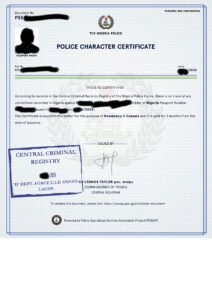
The completed Police Character Certificate will be sent directly to the applicant via email as a PDF document. The digital certificate includes:
- Your full name and personal details
- Certificate issue date
- Statement confirming no criminal record in Nigeria (or listing any criminal history if records exist)
- Unique certificate number beginning with “PSS” prefix
- QR code for online verification
- Digital signature and seal of the Nigerian Police Force
Step 6: Verify Your Certificate’s Authenticity
Foreign authorities increasingly require verification that Nigerian police certificates are genuine due to widespread document fraud concerns. The POSSAP system includes built-in verification functionality.
To verify a Nigerian Police Character Certificate:
- Visit the POSSAP portal at https://possap.gov.ng/
- Click “Validate Document” on the homepage
- Enter the certificate number (starts with “PSS”)
- Click “Proceed” to view verification results
The system will confirm whether the certificate is genuine, show issue date, and display certificate holder details. Many immigration authorities now independently verify Nigerian PCCs through this system before accepting applications.
Simple Checklist of Details Required to Apply for Nigerian PCC from Abroad
You generally need to have the following details ready in order to support the application for a Nigerian Police Character Certificate from abroad:
- NIN or BVN:
- SURNAME:
- OTHER NAME:
- DATE OF BIRTH:
- ADDRESS:
- PHONE NUMBER:
- EMAIL ADDRESS:
- COUNTRY OF ORIGIN:
- STATE OF ORIGIN:
- LOCAL GOVERNMENT AREA (OR MUNICIPALITY/HOME TOWN OF ORIGIN) OF ORIGIN:
- COPY OF INTERNATIONAL PASSPORT DATA PAGE & PASSPORT PHOTOGRAPH (FACE PHOTO)
- COUNTRY OF INTENDED TRAVEL (COUNTRY WHERE YOU INTEND TO USE THE PCC):
- REASON FOR THE CERTIFICATE (E.G. RESIDENCY, CITIZENSHIP, EMPLOYMENT, ETC.):
- CURENT COUNTRY OF RESIDENCE:
- PROOF OF RESIDENCE (E.G. RESIDENCE PERMIT, WORK PERMIT)
- FILLED BIOMETRIC CAPTURE FORM
Critical Limitation: Three-Month Validity Period
The Nigerian Police Character Certificate is valid for three months (90 days) from the date of issue. This creates significant timing challenges for applicants because many immigration applications take longer than three months to process.
Suggested Nigerian PCC Processing Timing for Immigration Applications
Canadian Express Entry: Applicants receive 90 days to submit complete applications after receiving Invitation to Apply (ITA). Canadian immigration recommends starting PCC processing immediately upon entering the Express Entry pool. However, if you need NIN enrollment first, you must account for the additional 2-6 weeks before you can even begin the POSSAP application, leaving very tight timelines.
UK Visa Applications: UK Home Office requires police certificates issued within the past 6 months, giving slightly more flexibility than the actual 3-month Nigerian validity period.
Australian Immigration: Australia typically requires police certificates to be issued within 12 months, but Nigerian PCCs may need to be more recent depending on application type.
USA Green Card Applications: USCIS requirements vary by application type, but generally police certificates should be current (within 6-12 months).
Portugal Golden Visa Applications: The Portugal Golden Visa Program lists ‘criminal record certificate’ (which refers to the Nigerian Police Character Certificate in this context) among the required documents for the application, the others being proof of investment, proof of health insurance, and a sworn statement confirming commitment to investment. The ‘criminal record certificate’ seeks to ensure that the applicant has a clean criminal record in Portugal, in their home country, and in Nigeria (hence the usefulness of the Nigerian Police Character Certificate). The Police Character Certificate should typically be issued within 90 days of your application appointment, and is required if you lived or worked in Nigeria for up to one year.
Planning Recommendation: If you don’t have NIN or BVN, start the NIN enrollment process at your nearest Nigerian embassy immediately, even before you receive immigration invitation or job offer. This ensures you have NIN ready when you need to apply for police certificate. The PCC application itself should be timed so the certificate arrives within 2-3 months of when you need to submit your immigration application.
If your PCC expires before you can submit your application, you must obtain a new certificate through the entire process again, including new application, new payment, new fingerprints, and new processing wait time.
Authentication and Legalization Requirements for International Use
In certain cases, foreign authorities may require the Nigerian PCC to be notarized, authenticated by the Ministry of Foreign Affairs, and in some cases legalized by the respective embassy before they will accept it as valid documentation.
When Authentication Is Required
Canada: For Canadian immigration applications (particularly Express Entry), Nigerian PCCs may need to be authenticated by Nigeria’s Ministry of Foreign Affairs in Abuja before submission. Always inquire to be sure of the current requirement.
European Union Countries: Many EU countries require Ministry of Foreign Affairs authentication of Nigerian police certificates. Some (e.g. Portugal) additionally require legalization at their embassies in Nigeria. Requirements vary by specific country.
United Kingdom: UK typically accepts POSSAP digital certificates without additional authentication, but some visa categories may require authentication depending on specific circumstances.
UAE, Qatar, Saudi Arabia: Gulf countries generally require both Ministry of Foreign Affairs authentication and embassy legalization before accepting Nigerian police character certificates for employment or residency applications. They also require that the PCC should be notarized. So if your destination is a Middle East/Gulf country such as the UAE, Qatar or Saudi Arabia, you need to notarize the PCC, authenticate it at Nigeria’s Ministry of Foreign Affairs, and legalize it at the country’s embassy in Nigeria.
USA: American immigration authorities typically accept Nigerian police certificates without requiring additional authentication, though individual states in the US may have varying requirements for employment background checks.
The PCC Authentication Process at Ministry of Foreign Affairs
If authentication is required, the process involves:
- Print Physical Certificate: The POSSAP digital certificate must be printed on high-quality paper
- Travel to Abuja: Authentication can only be performed at Ministry of Foreign Affairs headquarters in Abuja
- Legal Services Division: Submit the police certificate to the Legal Services Division for authentication
- Verification: Ministry of Foreign Affairs verifies the certificate with Nigerian Police Force
- Authentication Stamps: Once verified, Ministry officers affix authentication stamps and signatures on the back of the certificate
- Collection: Collect authenticated police character certificate (typically 3-5 business days processing)
For applicants living abroad, this requires either traveling to Nigeria specifically for authentication or engaging professional services with Nigeria-based representatives who can handle Ministry of Foreign Affairs authentication on their behalf.
Embassy Legalization of PCC (When Required)
After Ministry of Foreign Affairs authentication, some countries require additional legalization at their embassy in Nigeria:
- Notarize the Ministry of Foreign Affairs authenticated copy of the Police Character Certificate
- Take the Ministry of Foreign Affairs authenticated certificate to the relevant embassy in Abuja or Lagos
- Submit embassy legalization application with required documents
- Pay embassy legalization fees
- Wait for embassy processing
- Collect legalized certificate with embassy stamps
The combination of NIN enrollment (2-6 weeks if needed) + POSSAP application (2-4 weeks) + Ministry of Foreign Affairs authentication (1-2 weeks) + embassy legalization (1-3 weeks) means complete processing can take 8-12 weeks or longer when full authentication and legalization are required.
Special Considerations for Foreign Expatriates Who Worked in Nigeria
Foreign nationals face unique challenges when obtaining Nigerian Police Character Certificates because the POSSAP system and immigration requirements were primarily designed for Nigerian citizens.
The 30-Day Residence Threshold
Foreign nationals who resided in Nigeria for a minimum of 30 consecutive days are eligible to apply for Nigerian PCC. This includes:
- Expatriates who worked in Nigeria on employment visas or work permits
- Diplomats and embassy staff posted to Nigeria
- NGO workers and international organization employees
- Business visitors who spent extended periods in Nigeria
- Foreign students who attended Nigerian universities or schools
- Spouses and dependents of expatriates living in Nigeria
Immigration authorities in countries like Canada, Australia, and New Zealand specifically require police certificates from all countries where applicants lived for 30+ days (some set threshold at 6 months), making Nigerian PCC mandatory for anyone who spent significant time in Nigeria regardless of nationality.
Challenges for Foreign Expatriates
No BVN or NIN: Most foreign nationals who worked in Nigeria do not have Nigerian Bank Verification Numbers or National Identification Numbers. However, foreign expatriates can now obtain NIN by visiting Nigerian embassies in their home countries or current countries of residence. You will need to demonstrate you previously lived in Nigeria by providing documentation such as your passport with Nigerian visa stamps, Nigerian work permit or residence permit, employment contract showing Nigeria posting, or other proof of Nigerian residence.
Expired Nigerian Visas: Expatriates typically left Nigeria years ago and their Nigerian visas have long expired. When applying for NIN at the embassy, bring copies of your old Nigerian visas showing you lived in Nigeria during the relevant period.
Difficulty Proving Nigerian Residence: Unlike Nigerian citizens with permanent addresses, expatriates may struggle to provide exact Nigerian residential addresses from years ago, particularly if they lived in company-provided housing or relocated multiple times during their Nigeria assignment.
Solutions for Foreign Expatriates
NIN Enrollment at Embassy: The first and most important step is enrolling for NIN at the Nigerian embassy in your country. Contact the embassy to:
- Confirm they offer NIN enrollment for foreign nationals who previously lived in Nigeria
- Schedule your biometric capture appointment
- Bring comprehensive documentation of your Nigerian residence (visa stamps, work permits, employment contracts, residence permits)
- Complete NIN registration and receive your NIN number within 2-6 weeks
Professional Document Services: For expatriates who find the process too complex or time-consuming, professional services can coordinate NIN enrollment assistance, POSSAP application processing, fingerprint coordination, authentication when required, and international delivery.
Country-Specific Requirements and Considerations
Canada (Express Entry and All Immigration Programs)
Canadian immigration has strict police certificate requirements that create significant challenges for applicants with Nigerian connections:
- Required for: All Express Entry applications, spouse sponsorship, Provincial Nominee Programs, and citizenship applications
- Threshold: Required if you lived in Nigeria for 6 consecutive months or more since age 18
- Validity: Certificate must be issued within 6 months of application submission
- Authentication Required: Yes – Nigerian PCC must be authenticated at Ministry of Foreign Affairs AND authenticated at Nigerian High Commission in Ottawa
- Timeline: Allow minimum 10-12 weeks for complete processing including NIN enrollment if needed and authentication
- Critical: IRCC does not accept police certificates sent by mail for Express Entry applications – certificates must be uploaded digitally as PDF
- Rejection Risk: Incomplete authentication or expired certificates are common reasons for application rejection
United States (Green Card and Visa Applications)
USA immigration requirements are less standardized than Canada’s but still critical:
- Required for: Green card applications, marriage-based visas, employment-based immigration
- Threshold: Varies by application type – typically 6 months to 1 year of Nigerian residence
- Authentication: Generally not required – USCIS accepts Nigerian police certificates without additional authentication
- Format: Digital POSSAP certificates are accepted
- Validity Considerations: Should be recent (within 6-12 months) when submitted
United Kingdom (All Visa Categories)
UK visa applications require police certificates for many categories:
- Required for: Spouse visas, work visas, settlement (ILR), citizenship applications
- Threshold: Required if you lived in Nigeria for 12 consecutive months or more
- Validity: Certificate should be issued within past 6 months
- Authentication: Typically not required – UK Home Office accepts POSSAP certificates
- Special Note: UK immigration specifically accepts digital police certificates from POSSAP system
UAE, Qatar, and Gulf Countries
Gulf countries have strict police certificate requirements for all foreign workers:
- Required for: Employment visas, residency permits, visa renewals
- Authentication Required: Yes – both Ministry of Foreign Affairs authentication AND embassy legalization mandatory
- Frequency: May need to renew police certificate every 2-3 years for continued employment
- Special Considerations: UAE now processes authentication through VFS Global rather than embassy directly
Australia and New Zealand
These countries require comprehensive police certificates from all countries of residence:
- Threshold: Required if you lived in Nigeria for 12 consecutive months or more since age 16
- Validity: Certificate should be less than 12 months old
- Authentication: Typically not required
- Format: Digital certificates accepted
Common Problems and Practical Solutions
Problem 1: No BVN or NIN for POSSAP Access
Solution: Contact Nigerian embassy in your country immediately to schedule NIN enrollment appointment. Most Nigerian embassies now offer NIN enrollment for both diaspora Nigerians and foreign nationals who previously lived in Nigeria. Bring documentation proving your Nigerian residence or citizenship, complete biometric capture, and allow some time for NIN processing before you can begin POSSAP application.
Problem 2: Embassy Has Long Waiting Times for NIN Enrollment and Fingerprints
Solution: Book your NIN enrollment appointment as early as possible, ideally before you even need the police certificate urgently. Some applicants schedule NIN enrollment months in advance to ensure they have NIN ready when immigration deadlines arise. Consider visiting multiple Nigerian embassies if you live near borders or travel between countries frequently.
Problem 3: Certificate Expires Before Immigration Application Complete
Solution: Time your PCC application carefully, accounting for the additional NIN enrollment time if needed. For Canadian Express Entry, enroll for NIN immediately upon creating your Express Entry profile, then apply for PCC only after receiving Invitation to Apply. For other programs, calculate backwards from expected submission date and account for all processing steps.
Problem 4: POSSAP Payment System Rejects Foreign Cards
Solution: Use Nigerian bank accounts if available, engage professional document solutions services in Nigeria to handle the process (including making payments) on your behalf as part of their service.
Problem 5: Cannot Remember Exact Nigerian Addresses from Years Ago
Solution: Provide your best recollection with landmarks and general area. For expatriates, contact former employers to obtain address information from employment records. Police verification focuses on fingerprints, not address precision.
Problem 6: Authentication Requirements Not Clear for Destination Country
Solution: Contact the specific immigration authority, embassy, or employer requesting the certificate to confirm exact requirements before processing. Getting clarity upfront prevents expensive reprocessing later.
Professional Guidance on Getting Nigerian Police Character Certificate from Abroad
Navigating the process of obtaining a Police Character Certificate while living abroad can be time-consuming, technically confusing, and logistically challenging.
Antarch Consulting provides assistance for Nigerians abroad and foreign nationals who previously lived in Nigeria, who need guidance in processing a Nigerian Police Character Certificate from abroad after getting their NIN. To discuss how we might be able to assist, please CONTACT US.